
AI Prompt Generator: Why It Matters, Best Tools, and How to Use It
Discover how an AI prompt generator revolutionizes the way you work. A comprehensive guide to the best tools and how to use them for professional results in record time.

In a world where AI adoption is accelerating at an unprecedented pace, the AI prompt generator has become one of the most essential tools for anyone who wants to unlock the true potential of large language models. The difference between a user who gets ordinary results and one who achieves exceptional outcomes does not lie in the tool itself — it lies in the quality of the prompts they write.
This comprehensive guide will take you from zero to mastery: you will understand what a prompt generator is, why it has become a necessity rather than a luxury, and you will walk away with a curated list of the best available tools today, complete with real-world examples and practical steps you can apply immediately.
According to a 2024 McKinsey study, professionals who master writing AI prompts can complete their tasks up to 40% faster than their peers. A prompt generator is the bridge that gets you to that level.
What Is an AI Prompt Generator?
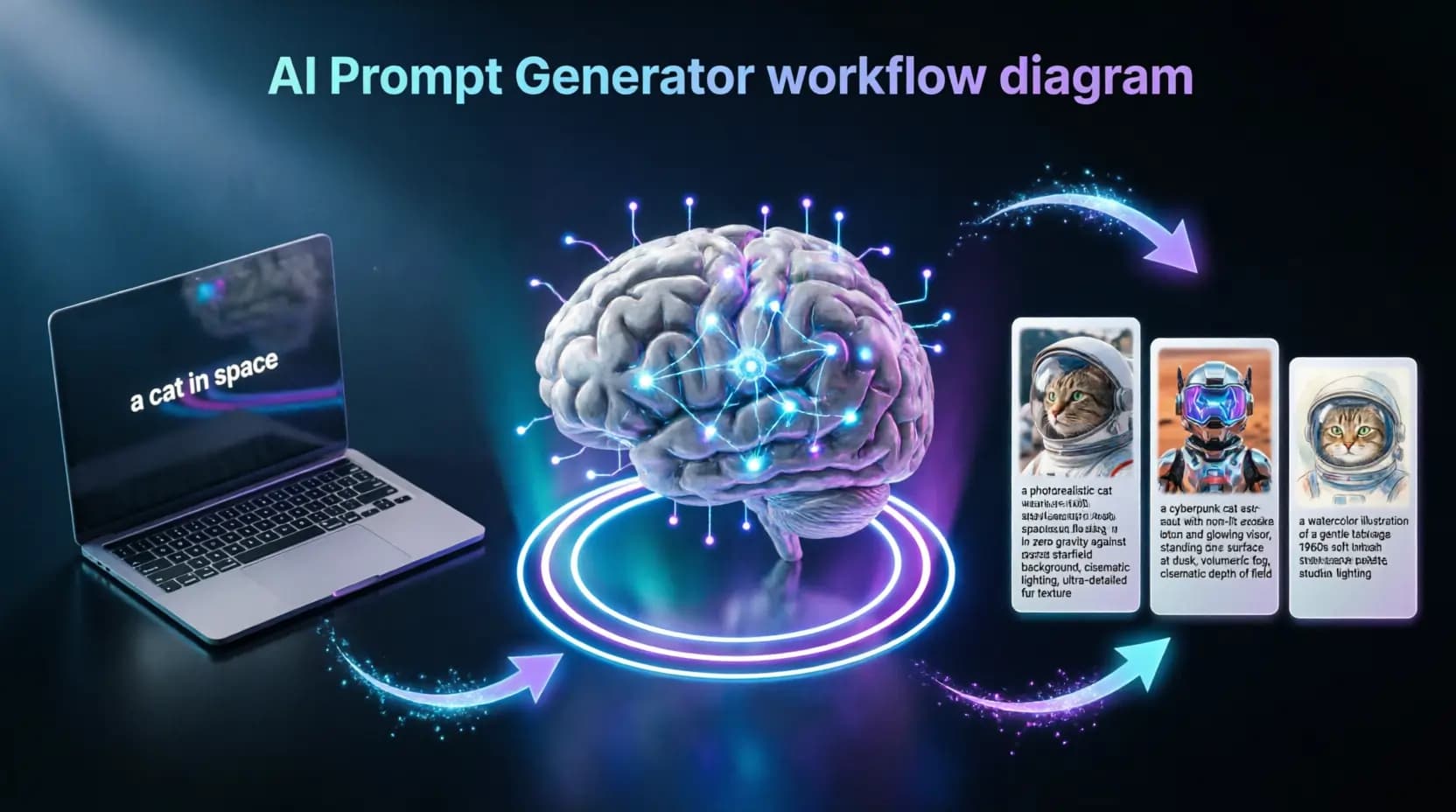
An AI prompt generator is an intelligent tool that helps you craft clear, precise, and well-structured instructions for AI models such as ChatGPT, Claude, Gemini, and others. Instead of staring at a blank page wondering "how do I phrase my request correctly?", the generator takes your basic inputs and transforms them into a polished, detailed prompt that produces superior results.
Imagine you want to write marketing copy for a new product. You might simply type: "Write a description for my product." The result will be acceptable but generic. If you use a prompt generator, it will ask you targeted questions: What is the product? Who is your target audience? What tone is required? Which platform will this be published on? It then builds a complete, professional prompt from your answers — one that produces copy on par with what top marketing agencies deliver.
Good generators operate on three levels: the first level is defining context and objective; the second level is adding constraints and technical requirements; and the third level is calibrating style, tone, and desired format. This three-tier structure is what makes automatically generated prompts outperform what the average user writes manually in most cases.
These tools serve as an intelligent bridge between the user's intent and the language model's capacity to understand and execute, converting general ideas or simple requirements into detailed, organized prompts that achieve the desired results with high precision.
At their core, prompt generators rely on advanced natural language processing (NLP) techniques to understand the context of a user's request, then construct it into an optimized template that contains all the necessary elements: the role expected of the AI, detailed context, clear instructions, illustrative examples, and specific quality standards. For instance, instead of writing a simple prompt like "write an article about marketing," a prompt generator can transform that request into a comprehensive instruction that specifies the article type, target audience, required length, appropriate tone, keywords, and organizational structure.
These tools are distinguished by their ability to adapt to a wide range of needs — whether you are looking to create marketing content, write code, analyze data, or generate creative ideas. By visiting our ready-made prompt library, you can browse hundreds of practical examples that demonstrate the power and effectiveness of this technology in improving output quality by up to 300% compared to random or poorly considered prompts.
Why AI Prompt Generators Matter in Today's World
AI is no longer the exclusive domain of developers and researchers. Today, teachers use it to prepare curricula, marketers use it to produce content, lawyers use it to draft contracts, doctors use it to search medical literature, and small business owners use it to manage their operations. But there is a shared challenge everyone faces: how do you communicate with AI in a way it truly understands and responds to as effectively as possible?
This is where the prompt generator becomes indispensable. In a world where companies compete on productivity and speed, those who master communication with AI hold a genuine competitive advantage. Real-world case study: Salesforce conducted an internal experiment and found that sales teams using specialized AI prompts produced presentations 60% faster and at higher quality — as rated by the clients themselves.
The second dimension of importance lies in democratizing knowledge. Before prompt generators existed, getting the most out of AI required deep technical knowledge of how language models work. Today, all you need to know is what you want — and the generator translates your intent into language the model understands perfectly.
The third dimension is standardization and consistency. In team environments, a prompt generator ensures that every team member communicates with AI at a uniformly high quality level, instead of results varying based on each person's individual prompting skill.
From an economic perspective, a compelling case study from a leading digital marketing agency shows that using advanced prompt generators contributed to a 450% increase in the content team's productivity within the first three months of adoption. The team went from producing 10 SEO-optimized articles per week to 50 — while maintaining high quality and reducing review and editing time by 60%. This radical transformation would not have been possible without the intelligent use of specialized prompt generation tools for SEO content creation.
On the educational and training front, prompt generators have become powerful learning tools that help both students and educators. In an educational experiment conducted at one university, students used a prompt generator to prepare their research and projects, and the results showed a marked improvement in the quality of submitted work — along with an average saving of 15 hours per student per week in research and writing time. These tools also contributed to the democratization of knowledge by giving non-native English speakers access to high-quality content in their own language through advanced translation capabilities.
OpenAI reports indicate that modern language models produce results that are 50% to 300% better when given well-structured, precise prompts compared to general ones. This enormous gap is the reason behind the growing interest in prompt generation tools.
How Does an AI Prompt Generator Help Users Every Day?
The real value of a prompt generator becomes clear in practical, everyday applications — not in abstract concepts. Let us explore how this tool transforms the experience of different types of users.
For content writers and bloggers: Instead of spending an hour figuring out how to phrase a request for an article, the writer enters their topic, keywords, and target audience into the generator and receives a complete prompt that produces an SEO-optimized article in minutes. One Arabic-language tech blogger shared his experience: before adopting a prompt generator, he produced 4 articles per week. After using one, he now produces 12 articles per week — at higher quality.
For small business owners: An e-commerce store owner selling handmade products does not have the budget to hire a content writer. They use a prompt generator to create prompts that write product descriptions, responses to customer reviews, social media posts, and even marketing emails — all at negligible cost.
For teachers and academics: A university professor in Saudi Arabia told us she uses the Promptsa prompt generator to create interactive exercises, exam questions, and lecture summaries. What used to take two days now gets done in two hours, leaving her more time to engage with her students.
For developers and programmers: Writing prompts that help AI generate, review, or explain code has become a core skill. A prompt generator helps developers craft the prompt that produces the most accurate and efficient code — eliminating the need for trial and error.
For entrepreneurs and e-commerce store owners, a product description generator is an invaluable asset. A case study from an online store selling natural products illustrates how the store owner managed to write compelling descriptions for over 200 products in a single day — using a prompt generator that accounted for each product's unique features, customer benefits, search-optimized keywords, and appropriate emotional tone. An effort that would have taken weeks was completed in just a few hours, allowing the store to launch a full month ahead of schedule.
In the creative and design space, a logo prompt generator helps designers and startup founders explore multiple creative ideas at record speed. A freelance graphic designer shared: "I used to spend 3 to 4 days developing 5 logo concepts for a client. Now, with a prompt generator, I can present 20 different concepts in a single working session — which has increased client satisfaction and my income by 150%." You can explore more practical examples in our comprehensive guide on logo prompts.
The Top 10 AI Prompt Generators You Should Try
In the rapidly growing market for AI tools, several platforms stand out for offering innovative prompt generation solutions. Based on our comprehensive testing and user feedback, here are the top 10 prompt generators you should try in 2026:
1. Promptsa — Tops our list as a comprehensive, versatile tool that combines ease of use with professional-grade power. It stands out for its multilingual interface, a large library of ready-made templates, and advanced prompt optimization algorithms.
2. PromptPerfect — A professional tool focused on optimizing prompts for advanced models like GPT-4 and Claude 3. It allows you to compare results across different models and provides detailed quality analysis of your prompts. Ideal for developers and companies that require high-precision outputs.
3. PromptBase — A unique platform that lets you not only generate prompts but also buy and sell professionally crafted prompts from experts. It contains over 10,000 specialized prompts spanning diverse fields from marketing to programming.
4. AIPRM for ChatGPT — A powerful browser extension that transforms ChatGPT into a professional tool with hundreds of ready-made templates. It is distinguished by continuous updates from an active user community and covers diverse needs such as article writing and SEO optimization.
5. FlowGPT — An open-source platform for sharing and collaborating on prompts. Ideal for teams and educational institutions, with advanced features for project management and shared libraries.
6. PromptHero — Specialized in image-generation prompts for models like Midjourney, Stable Diffusion, and DALL-E. Contains millions of practical examples with advanced search capabilities by style and subject.
7. LangChain Hub — An advanced platform for developers to create and manage complex prompt chains. Ideal for building integrated AI applications and automated systems.
8. PromptLayer — Focused on tracking and analyzing prompt performance in production environments. Offers advanced monitoring and continuous improvement tools, with seamless integration across most major AI platforms.
9. Vellum — A professional tool for development teams that enables A/B testing of prompts, real-time collaboration, and direct deployment of optimized prompts into applications.
10. Humanloop — Combines prompt generation with machine learning to continuously improve performance. Ideal for companies seeking scalable solutions with robust quality assurance.
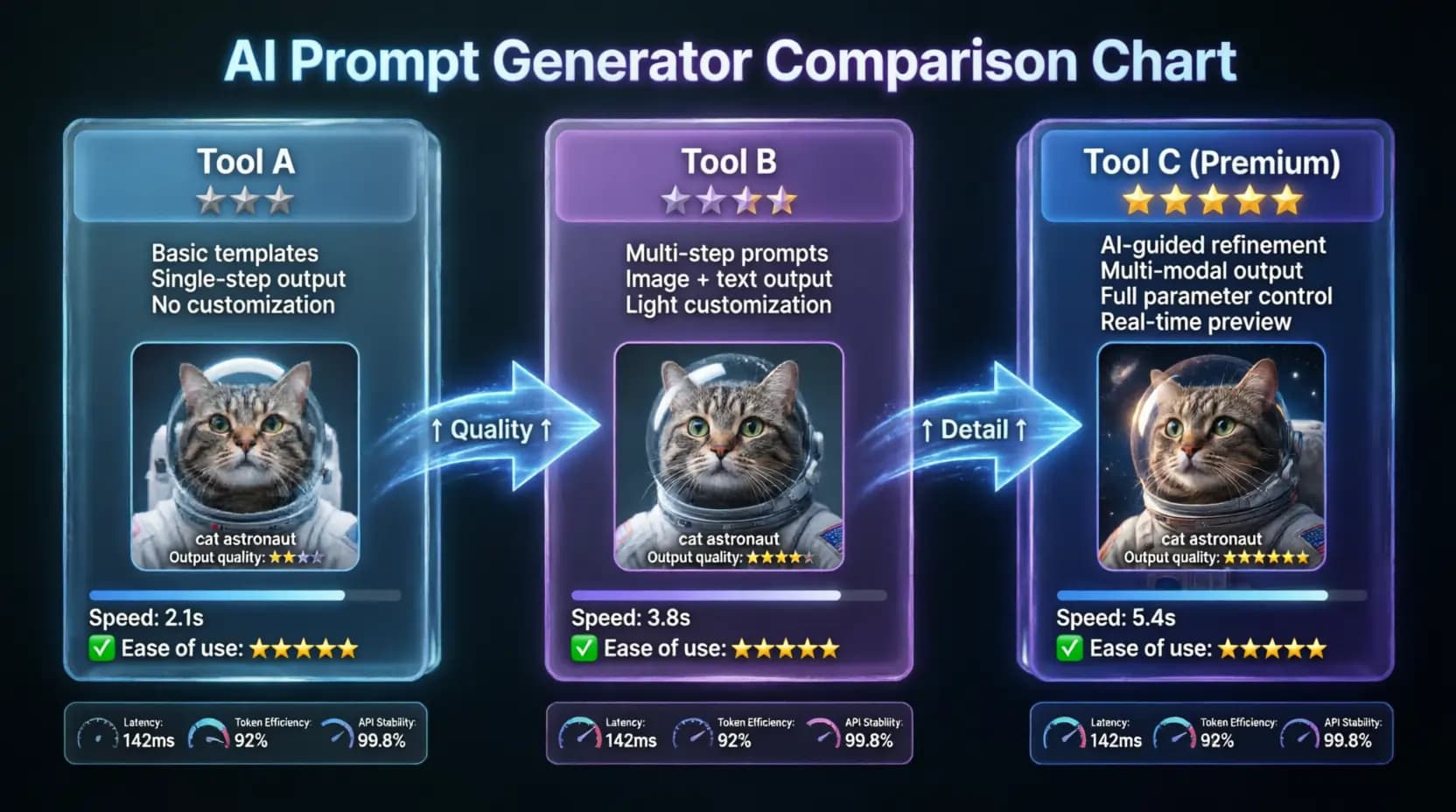
For a detailed comparison of these tools to help you choose the right one for your needs, we recommend visiting our article on best free AI prompt generators, which includes a comprehensive feature and pricing comparison table.
Why Promptsa Leads the Pack
Promptsa is the only tool on this list that was built from the ground up to support multiple languages — not as an afterthought. It offers 15 specialized prompt generator types, including an SEO prompt generator, an ad prompt generator, an infographic prompt generator, a product description generator, a logo prompt generator, and more.
What truly sets it apart is that it does not just hand you a finished prompt — it lets you customize it for the specific AI model you plan to use, whether that is ChatGPT, Claude, or Gemini, with a single click to open the prompt directly in your tool of choice.
How to Choose the Best AI Prompt Generator for Your Needs
To get maximum value from an AI prompt generator, it is essential to follow a structured methodology that ensures accurate, high-quality results. Let us walk through a practical, step-by-step journey supported by real examples from users who have achieved tangible success.
Step one: Define your goal with clarity — even before opening the tool, take five minutes to pinpoint exactly what you want. Ask yourself: what is the final output I need? Who is the target audience? What are the core success criteria? For example, instead of saying "I want an article," say "I want a 1,500-word article about the benefits of AI in education, aimed at teachers, written in a practical style with real-world application examples, optimized for the keyword 'smart education'." This level of clarity enables the generator to create a precise prompt.
Step two: Choose the right template — most advanced tools like our prompt library offer pre-designed templates for different needs. Choose the template closest to your goal as a starting point. If you are creating a product description, use the product description template, which automatically accounts for essential elements like features, benefits, and a call to action. In one case study, a tech blog used a ready-made article template and then customized it to match their style — saving 70% of the time compared to starting from scratch.
Step three: Enter contextual information — this is where the true power of prompt generators lies. Provide as much relevant detail as possible: information about your brand, your preferred voice and tone, examples of previous work you admired, specific constraints (like avoiding technical jargon), and any special requirements. The richer the context, the better the result. A marketing consultant shared: "When I added detailed information about my ideal customer persona and the buying journey, the quality of the generated content improved by 85%."
Step four: Iterate and refine — the first result is rarely 100% perfect. Use the prompt refinement feature to adjust outputs. If the article is too long, ask for a condensed version. If the tone is too formal, request a more conversational style. Each iteration helps the tool learn your preferences, improving future results. Start by trying the copy-paste ready prompts and customize them gradually.
Step five: Test and validate — before finalizing any outputs, test them on a small scale. Post the content to a test group, share the article with a colleague, or trial the product description with a limited number of visitors. Collect feedback and evaluate real performance — click rates, engagement, sales. Use this data to refine your prompts going forward, creating a continuous improvement cycle.
Getting Maximum Value from Any Prompt Generator
Choosing the right prompt generation tool depends on five core criteria — knowing them upfront saves you considerable time in trial and error.
1. Specialization versus breadth: Do you need a tool that does everything adequately, or one that specializes in your field and does one thing with outstanding professionalism? If your work is in digital marketing, a tool specialized in marketing prompts will produce better results than a general-purpose one.
2. Ease of use and learning curve: A tool that requires hours to learn will discourage you before you even begin. Look for an intuitive interface that lets you start immediately and learn advanced features gradually.
3. Integration with your existing tools: Do you primarily work with ChatGPT? Look for a generator that sends prompts directly to it. Do you use Claude? Make sure it is supported. Seamless integration eliminates friction that reduces your consistency in using the tool.
4. Continuous updates: AI models evolve rapidly. A tool whose prompts are not updated to align with the latest models will deliver diminishing results over time. Check the date of the last update and how frequently new prompts are released.
Beware of tools that sell "magic prompts" with exaggerated claims. There is no single prompt that works in all situations. Good prompts always require customization for your specific case, and any tool claiming otherwise is selling you an illusion.
How to Use a Prompt Generator Effectively: A Step-by-Step Guide
Knowing about a tool is one thing — mastering how to use it is another. These practical steps will ensure you extract maximum value from any prompt generator.
Step 1: Define Your Goal Precisely Before Opening the Generator
The biggest mistake beginners make is opening a prompt generator without knowing exactly what they want. Before anything else, write down — on paper or in a note — the precise output you are looking for: What is its ideal length? What tone is appropriate? What information must it contain?
Real-world example: Instead of "I want an article about marketing," write: "I want a 1,500-word article about email marketing strategies for small e-commerce store owners in the US market, written in a direct and practical tone, including 5 actionable tips with examples and real success metrics."
Step 2: Enter Information into the Generator in the Right Order
Most good prompt generators present you with a series of fields. The optimal input order is: subject or type first, then audience, then objective, then constraints and requirements, and finally style and format.
Do not fill any field with generic placeholder text. The more specific your inputs, the more powerful the generated prompt. Try the Promptsa prompt generator, which guides you through these steps in an intuitive way.
Step 3: Review the Generated Prompt Before Using It
The generator produces a solid prompt, but you know your specific needs best. Read through the generated prompt and add any personal details: your brand name, words you want to avoid, competitors you do not want mentioned, or sensitive information that should be removed.
Step 4: Test and Iterate
Do not expect perfection on the first attempt. Use the prompt with your preferred AI model, then return to the generator and add refinement notes. After two or three improvement cycles, you will arrive at a "master prompt" for your recurring tasks — one you can save and reuse consistently.
You are an expert in digital content writing and SEO. Write a comprehensive article about [topic] according to the following specifications:Target audience: [describe your audience — example: early-stage entrepreneurs in the US market]
Article objective: [informational / persuasive / educational / entertaining]
Primary keywords: [keyword 1], [keyword 2], [keyword 3]
Article length: [1,500 – 2,000] wordsRequired article structure:
A compelling introduction that poses a problem or thought-provoking question (150 words)
[number] main sections, each with an H2 heading that includes the primary keyword
At least one real-world example or case study in the middle of the article
A conclusion summarizing key points and inviting engagement (100 words)
Style requirements:
Tone: [professional / conversational / neutral]
Short sentences, no more than 20 words each
Primary keyword in the main title, the first paragraph, and every 200 words
Avoid filler content and unjustified repetition
Use numbers and statistics where available
Format: clear H2 and H3 headings, bullet points where appropriate, paragraphs between 80–120 wordsYou are a professional marketing copywriter specializing in open-market platforms. Your task is to write [content type: product description / social post / ad / email] for the following product:Product name: [product name]
Product category: [category]
Key features: [feature 1], [feature 2], [feature 3]
Price: [price and currency]
Target audience: [precise description of the ideal customer]
Platform: [where this content will be published]Required style:
Open with a Hook that captures attention within the first 5 seconds
Focus on user benefits, not just technical specifications
Use social proof where possible (numbers, representative testimonials)
Close with a clear and specific Call to Action
Avoid unsubstantiated exaggerated claims
Constraints: [anything to avoid — specific words, competitors, claims...]
Length: [required word count]Common Mistakes to Avoid When Using Prompt Generators
Knowing the pitfalls in advance saves you frustration and wasted time. These are the mistakes that 80% of new users make.
Mistake one: Intentional vagueness. Some users leave fields blank or enter overly general information, assuming the generator will "figure out" what they mean. The generator is intelligent, but it is not a mind reader. The more specific you are, the stronger the output.
Mistake two: Using the generated prompt without reviewing it. The generated prompt is a starting point, not a final product. Always review it and add what is specific to you: your brand information, your own examples, and any sensitive details you do not want shared with an external tool.
Mistake three: Expecting a perfect result on the first try. Even the best prompts require adjustments. Plan for two or three rounds of use and refinement. Save the prompts that work well for future use.
Mistake four: Using the same prompt across different AI models. ChatGPT, Claude, and Gemini each have different response styles. A prompt that produces excellent results in ChatGPT may need a small adjustment to work just as effectively in Claude. Tools like the Promptsa prompt optimizer help you adapt your prompts for each model.
Mistake five: Neglecting to save successful prompts. When you find a prompt that produces excellent results for a recurring task, save it in a file or in the prompt library. You will gradually build a personal prompt library that saves you significant time.
Never enter confidential, personal, or sensitive business information into a prompt generator. Most AI tools use your inputs to improve their models. For sensitive projects, use local models or enterprise solutions with clear privacy agreements.
The Difference Between a Prompt Generator and an AI Writing Assistant
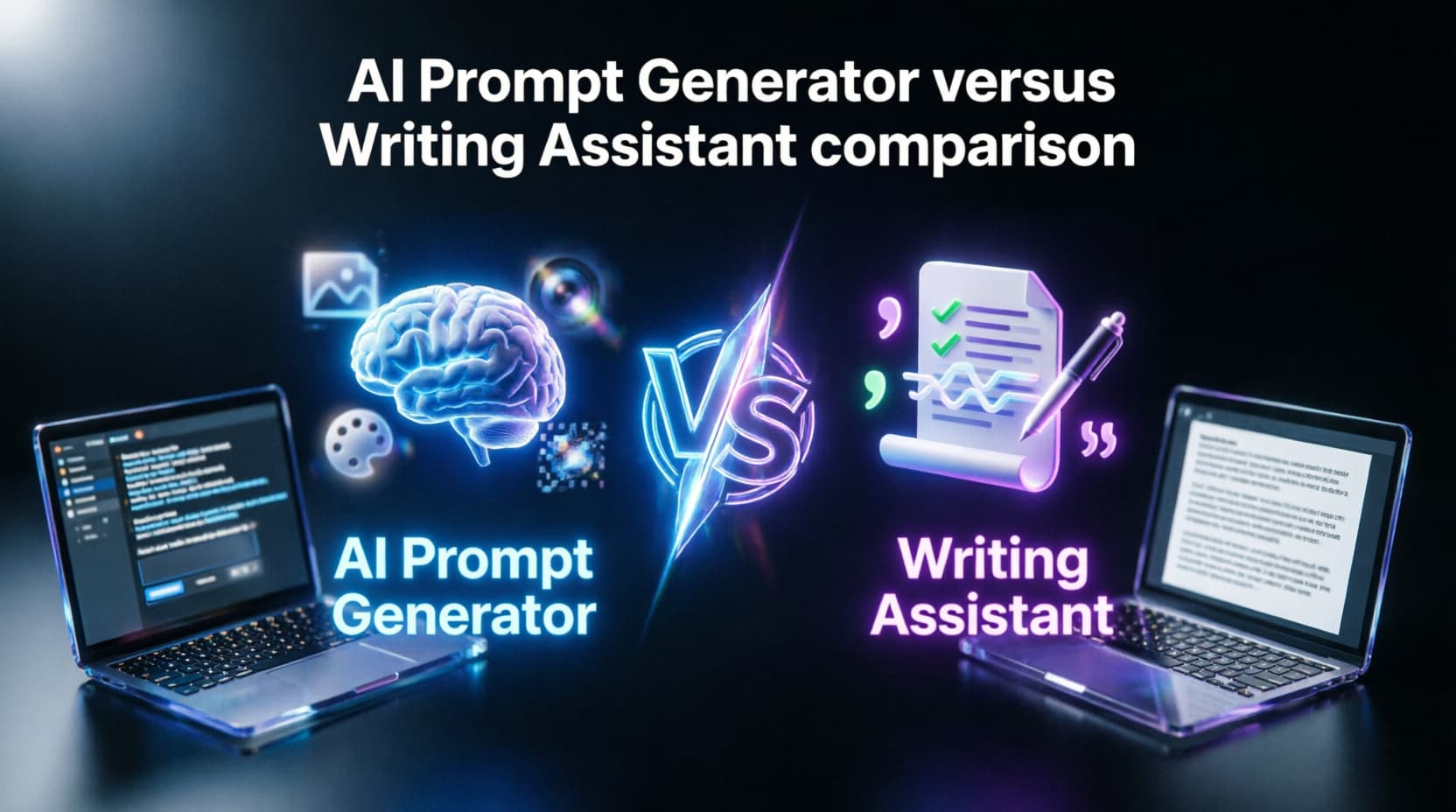
Although both tools rely on AI and are used to create content, there are fundamental differences between them that significantly affect how each should be used and what results to expect. Understanding these distinctions helps you choose the right tool for each task and achieve better outcomes.
A prompt generator focuses on creating the "instructions" that will be given to an AI model. Think of it as an architect who designs the detailed blueprint before construction begins. Its job is to transform your general idea into a precise, organized, and optimized instruction that the model can understand perfectly. For example, if you want to write an article, the prompt generator does not write the article itself — it writes the prompt that will make ChatGPT write the article in the best possible way. This includes defining structure, tone, length, keywords, and examples.
An AI writing assistant — such as ChatGPT or Claude used directly — is the tool that executes the instructions and produces the actual content. Think of it as the builder who implements the blueprint. Its job is to understand the prompt and execute it with creativity and precision. The key distinction is that the writing assistant operates based on the instructions you give it, while the prompt generator helps you craft those instructions professionally.
To illustrate the difference practically, consider a real example: a marketing agency wanted to create an email campaign. They first used a prompt generator to create a detailed prompt specifying: the type of campaign (promotional), the audience (prospective customers), the goal (increase sales by 20%), the number of emails (5), the sending interval (two weeks), the tone (persuasive but not intrusive), and the required elements (compelling subject line, personalized content, clear call to action). They then used this prompt with their writing assistant (ChatGPT), which produced all five complete email copies.
The result was a professional campaign that achieved a 45% open rate (compared to the industry average of 20%) and a 12% conversion rate. Had they used the writing assistant directly without the prompt generator, the results would have been inconsistent and unpredictable. For a deeper understanding of how these tools interact, read our article comparing ChatGPT, Claude, and Gemini.
How to Build Your Personal Library of Golden Prompts
Reaching true mastery in using prompt generators means building a personal library of prompts that work exceptionally well for your specific use cases. This library is a genuine asset that grows in value over time.
Start by categorizing your recurring tasks: what do you ask AI to do more than twice a week? These are your prime candidates for crafting well-honed, dedicated prompts. For each task, start with a prompt generated by Promptsa, test it, refine it, and save the best version.
Over time, you will notice that your prompts have become more precise and effective. What once took three attempts now works on the first try. What used to take an hour now gets done in ten minutes.
You can also take advantage of the ready-made prompt library at Promptsa, which contains hundreds of tested prompts across multiple fields. Or browse our blog for the latest techniques and strategies in professional prompt writing.
You might also like

Discover the best free AI-powered image merging tools online. Learn how to merge two images into one seamlessly with AI — no Photoshop, no skills, no cost. Complete guide with 20+ tools, step-by-step tutorials, and expert tips for 2026.

A comprehensive guide to the best AI prompts for professional logo design, featuring ready-made templates, tool comparisons, and practical tips for every business type.
Master 12 proven ChatGPT prompt secrets: role prompting, chain-of-thought, custom instructions & GPTs. Updated for 2026.
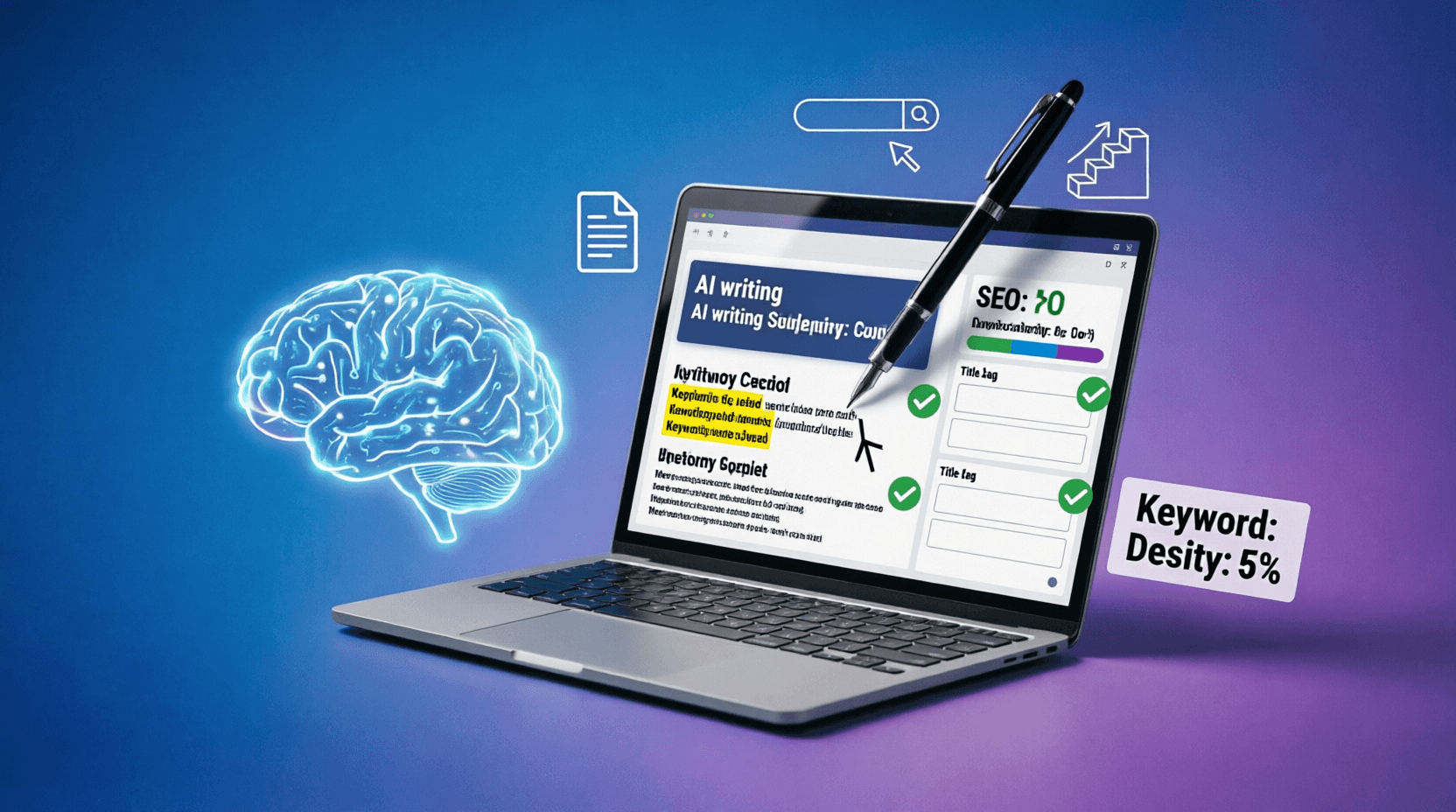
Struggling to rank AI-written content? This step-by-step AI SEO content guide covers keyword strategy, EEAT, prompt engineering, and a 12-step workflow — with real examples and templates you can copy today.