
AI SEO Content Guide: The Complete Framework to Write Content That Ranks
Struggling to rank AI-written content? This step-by-step AI SEO content guide covers keyword strategy, EEAT, prompt engineering, and a 12-step workflow — with real examples and templates you can copy today.
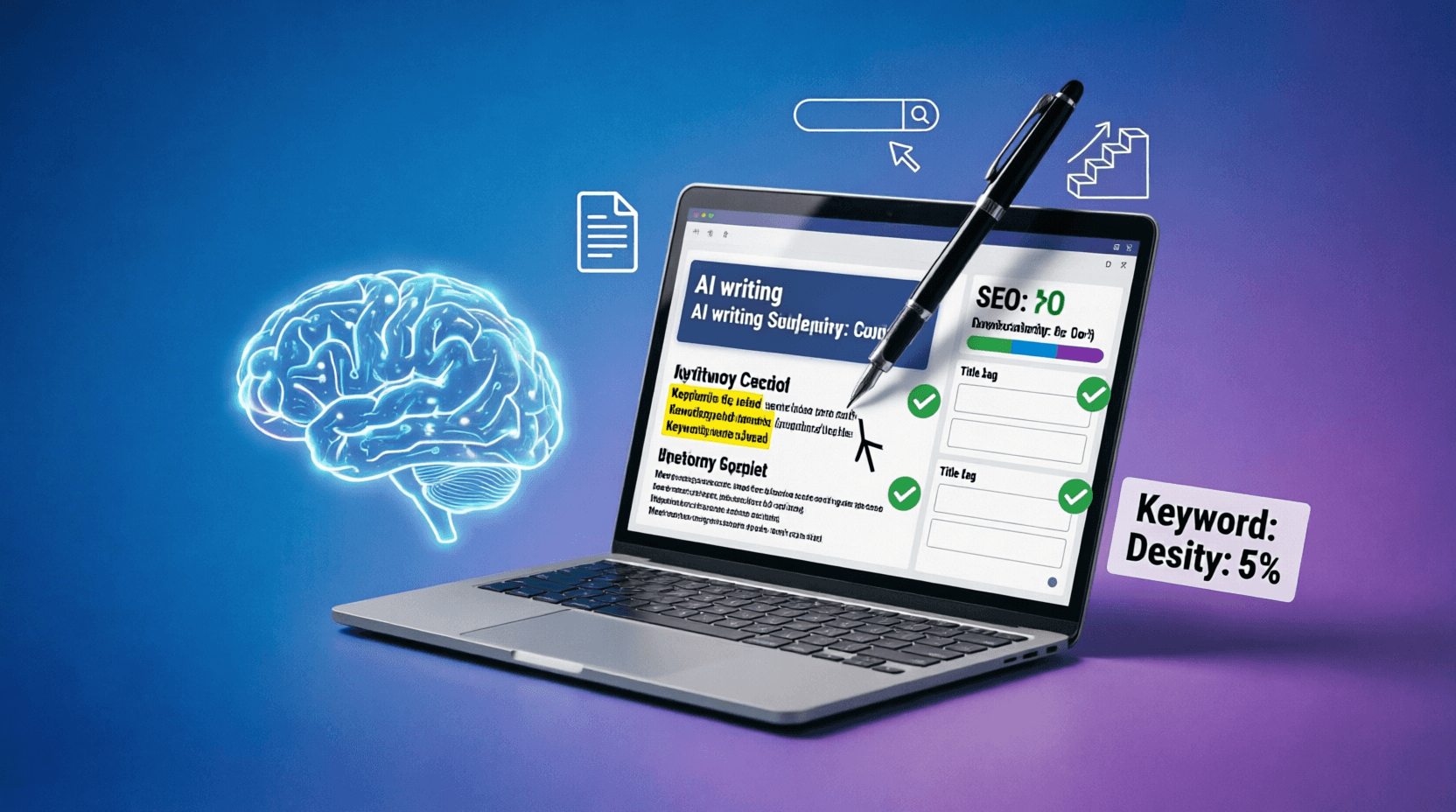
TL;DR: This comprehensive guide reveals exactly how to create AI-powered SEO content that ranks. You'll learn a proven 12-step workflow, discover how to align content with search intent, avoid the EEAT mistakes that quietly kill rankings, and get a ready-to-use prompt template that generates ranking-focused articles.
The Modern SEO Reality: Why Generic Content Fails
SEO content today is no longer about publishing lengthy articles and mechanically repeating a target keyword. Search competition is tighter, user expectations are higher, and Google's algorithms are exceptionally adept at distinguishing between genuinely useful, expert-driven content and generic filler.
The Hard Truth: Google's Helpful Content Update and AI detection systems now systematically penalize low-effort, templated content. Pages that fail to demonstrate real expertise or user value find themselves pushed down in search results, regardless of how many backlinks they've accumulated.
The real question is no longer whether AI can help write SEO content. The real question is how to strategically use AI to create content that truly deserves to rank. The answer lies in understanding the fundamental principles of SEO content creation and using AI as a powerful lever, not a replacement for human judgment — in short, learning how to write SEO content using AI the right way, not the fast way.
That is where purpose-built tools like our AI SEO Generator, free prompt generator, AI Prompt Optimizer, AI Article Prompt Generator, and our comprehensive Prompt Engineering guide become indispensable.
The goal is not to let AI write blindly. The goal is to leverage AI to accelerate research, structure, draft creation, and refinement while ensuring the final output aligns perfectly with real user search intent.
This comprehensive guide will walk you through everything you need to know: what AI SEO content truly is, what makes a page rank-worthy in the current landscape, how to choose high-impact keywords, how to write stronger prompts, and how to build a repeatable, scalable workflow around SEO content creation.
Understanding AI SEO Content: Beyond the Buzzword
What Is AI SEO Content?
AI SEO content is content created, structured, or significantly improved with the help of artificial intelligence tools to target search visibility more effectively. The point is not just speed or volume—it's about creating more strategic, targeted, and valuable content that serves both users and search engines.
✅ What Good AI SEO Content Helps You Do:
- Build stronger first drafts in a fraction of the time, allowing your team to focus on strategy rather than staring at a blank page.
- Cover complex topics completely by identifying and filling content gaps that might otherwise go unnoticed.
- Improve heading structure with better H1, H2, and H3 hierarchy, enhancing both readability and crawlability.
- Align precisely with keyword intent (informational, commercial, or transactional), ensuring you meet user expectations.
- Publish high-quality content consistently across your entire site, building topical authority over time.
🚫 What AI SEO Content Is NOT:
AI SEO content is not a magic button for instant rankings. It is not a replacement for human expertise and editorial judgment. It should never be an excuse to publish generic, unedited content, and it is absolutely not a way to bypass EEAT requirements or manipulate search engines.
Why AI SEO Matters More Than Ever
Content teams face unprecedented pressure. Speed expectations continue to rise, requiring teams to publish more pages faster. Quality demands remain high, while search algorithms have become increasingly sophisticated at detecting shallow, low-value content. At the same time, user patience has diminished significantly, with visitors abandoning weak pages within seconds.
Editor's note: Engagement and conversion figures for EEAT-strong content vary a lot by niche and traffic source. Rather than quote a single industry-wide percentage, treat EEAT as a qualitative bar: content that shows real experience and cites real sources consistently outperforms generic content in click-through rate and dwell time. If you want a hard number here, pull it from your own Search Console data rather than a third-party average.
How AI Solves These Challenges:
- Accelerates drafting: Gets you to a usable, well-structured first draft faster, freeing up time for strategic thinking.
- Enables rapid iteration: Allows you to test multiple article angles and headline variations quickly.
- Facilitates scalable optimization: Helps build optimized meta titles, descriptions, and FAQ sections at scale.
- Strengthens content ecosystems: Supports core service pages with topically relevant supporting content.
The Anatomy of Content That Actually Ranks
The 7 Non-Negotiable Elements of Ranking Content
Strong SEO content requires more than just keyword targeting. Here's what ranking content must include:
- Clear search intent alignment: Your content must directly answer the user's underlying goal rather than just vaguely addressing a keyword.
- A strong, compelling H1: Captures attention immediately, includes your primary keyword naturally, and promises clear value.
- Logical H2 and H3 structure: Breaks down complex information into digestible, scannable chunks, guiding the reader and helping search engines understand hierarchy.
- Complete topic coverage: Answers both the main question and related sub-questions, leaving no relevant aspect unexplored.
- Practical frameworks: Provides actionable, EEAT-demonstrating value through templates, workflows, and decision trees.
- Smart internal linking: Connects to related services and pillar content, helping users navigate and search engines understand your content architecture.
- A clear next step: Guides users toward conversion with a relevant, contextual call to action.
Before & After: What Makes Content Rank vs. Flop
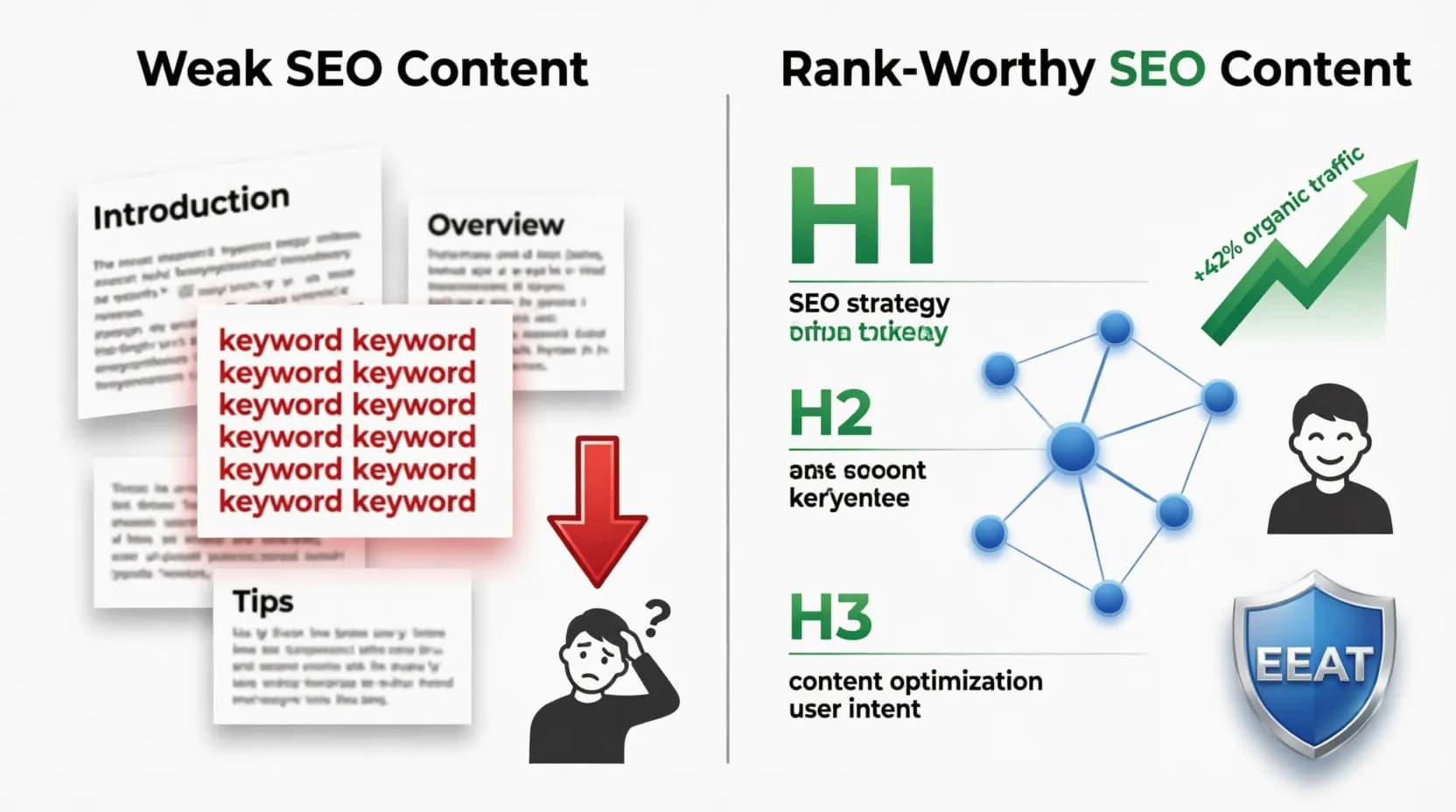
| Feature | ❌ Weak SEO Content (Flops) | ✅ Rank-Worthy SEO Content (Wins) |
|---|---|---|
| Title & H1 | Generic, redundant (e.g., "SEO Content") | Compelling, keyword-rich, promises clear value |
| Keyword Usage | Mechanical stuffing, unnatural flow | Natural, semantic, integrated smoothly into context |
| Structure | Vague headings ("Introduction", "Conclusion") | Logical H2/H3 hierarchy guiding the user journey |
| Value Provided | Generic advice found on hundreds of other sites | Unique frameworks, templates, and actionable steps |
| Call to Action | Bland "Contact us" with no context | Relevant, contextual, and conversion-focused |
| Result | High bounce rate, low rankings, zero conversions | Lower bounce rate, higher rankings, increased conversions |
The SEO Content Prompt Engineering Framework
Why Your Prompts Define Your Results
The quality of your AI output is directly proportional to the quality of your input. A vague prompt yields vague results. Instead of asking for a generic article, provide a structured, role-based command that gives the AI clear direction. This is really the core of best prompts for AI SEO: specificity beats cleverness every time.
The Golden Rule of AI SEO Content: Garbage in = garbage out. The more specific your instructions regarding tone, audience, structure, and required elements, the better your results.
The Master SEO Prompt Template
You are an expert SEO content strategist and writer.
Create a comprehensive, rank-worthy article about: [topic]

Primary keyword: [primary keyword]
Secondary keywords: [secondary keyword 1], [secondary keyword 2]
Search intent: [informational / commercial / transactional]
Target audience: [specific audience, e.g., SaaS founders, ecommerce marketers]
Desired length: [e.g., 1,500 - 2,000 words]

Requirements:
- Craft a compelling, click-worthy H1 that includes the primary keyword.
- Write a short, engaging introduction that hooks the reader and states the article's value.
- Structure the body with logical H2 and H3 headings that cover the topic comprehensively.
- Include practical examples, actionable steps, or frameworks in each major section.
- Add a dedicated FAQ section addressing 3-5 real user questions (People Also Ask).
- End with a clear, relevant Call to Action (CTA).
- Use keywords naturally; avoid keyword stuffing.
- Maintain a professional, educational, and conversion-focused tone.

Language: English
Pro Tip: For a faster first draft, use the free prompt generator to brainstorm ideas, and then refine the result with the AI Prompt Optimizer to ensure it meets professional standards.
Strategic Keyword Selection for Maximum Impact
The 3-Layer Keyword Framework
One of the biggest mistakes in SEO content is choosing a broad, highly competitive keyword and then writing an equally broad, unfocused article. Instead of chasing the most competitive keyword, build a content ecosystem around related topics.
- Layer 1: Primary Keyword: The main phrase the page should revolve around (e.g., "AI SEO content"). It should have realistic search volume and align with your business goals.
- Layer 2: Secondary Keywords: Related phrases and semantic variations that support the main topic naturally. Beyond the obvious variations, target real long-tail queries people type into Google, such as:
- how to write SEO content using AI
- best prompts for AI SEO
- EEAT in AI content
- AI SEO content examples
- AI generated content SEO best practices
- AI SEO generator vs. writing content manually
- Layer 3: Search-Driven Questions: Specific, long-tail queries that real users are asking (e.g., "Can AI write SEO content well?", "How do I make EEAT in AI content stronger?"). These address "People Also Ask" boxes and featured snippet opportunities.
Why long-tail matters more than it looks: A query like "how to write SEO content using AI" has lower volume than "AI SEO content," but it converts better because the searcher's intent is explicit — they want a process, not just a definition. Building a section or a supporting article around each long-tail phrase is one of the fastest ways to capture featured snippets.
Choosing Your SEO Strategy
12 Proven Tactics to Supercharge Your AI SEO Content
Each of these tactics addresses a specific, common failure point in AI-assisted content production.
- Start from search intent, not just the keyword. Understand why the user is searching (buy, learn, or compare) and tailor the content to that specific goal.
- Give the model a clear audience. Specify if you are writing for beginners, C-level executives, or technical developers to adjust tone and complexity.
- Ask for structure before full copy. Generate an outline first, review the H2s and H3s, and ensure logical flow before generating the full draft.
- Use keywords naturally, not mechanically. Modern search engines understand semantic context. Focus on covering the topic thoroughly, including natural variations like "AI generated content SEO best practices."
- Add practical examples and concrete steps. Inject real-world examples, case studies, or proprietary frameworks to add unique value competitors can't replicate.
- Build FAQ sections around actual user questions. Use "People Also Ask" to find real questions and have the AI answer them concisely to capture featured snippets.
- Generate multiple headline options before choosing one. Ask for 10 H1 variations and pick the one that is both SEO-friendly and highly clickable.
- Improve the title and meta description separately. Prompt the AI specifically to optimize these elements for maximum CTR after the article is written — a strong title alone can lift click-through rate meaningfully even at the same ranking position.
- Run the draft through the AI Prompt Optimizer. Refine your initial prompts or improve the clarity and flow of the generated draft before publishing.
- Add strong internal links to related services and posts. Link contextually to your Prompt Engineering guide to keep users on your site longer.
- Never publish the first output untouched. Human editorial review is non-negotiable. Fact-check, refine tone, and ensure brand alignment.
- Turn isolated posts into a content cluster. Create a pillar page and link it to several supporting cluster posts to dominate a specific topic and build topical authority.
The Integrated Ecosystem: How SEO Content Supports Your Core Services
Strong content should help the rest of the site, not sit alone in a vacuum. Every piece of content should serve multiple purposes: educate users, build authority, and guide visitors toward conversion.
- AI SEO Generator: The primary tool for content implementation. Users ready to create content can start immediately.
- AI Article Prompt Generator: Supports content ideation by providing structured prompts, removing writer's block.
- AI Prompt Optimizer: Handles refinement, bridging the gap between initial drafts and polished, professional content.
- AI Social Media Content Generator: Repurposes published content into social media snippets, maximizing the value of each piece.
- Complete Services page: The hub that connects all tools together, offering comprehensive solutions for every content need.
- Free Prompt Generator: A quick start option for users who want no-frills ideation immediately, lowering the barrier to entry.
- Prompt Engineering Guide: In-depth education for users wanting to master prompt writing, encouraging deeper engagement.
A Scalable Workflow for SEO Content Production
This workflow creates a scalable content machine, not just a single, isolated article. By following these steps consistently, you can build a content production system that delivers results at scale.
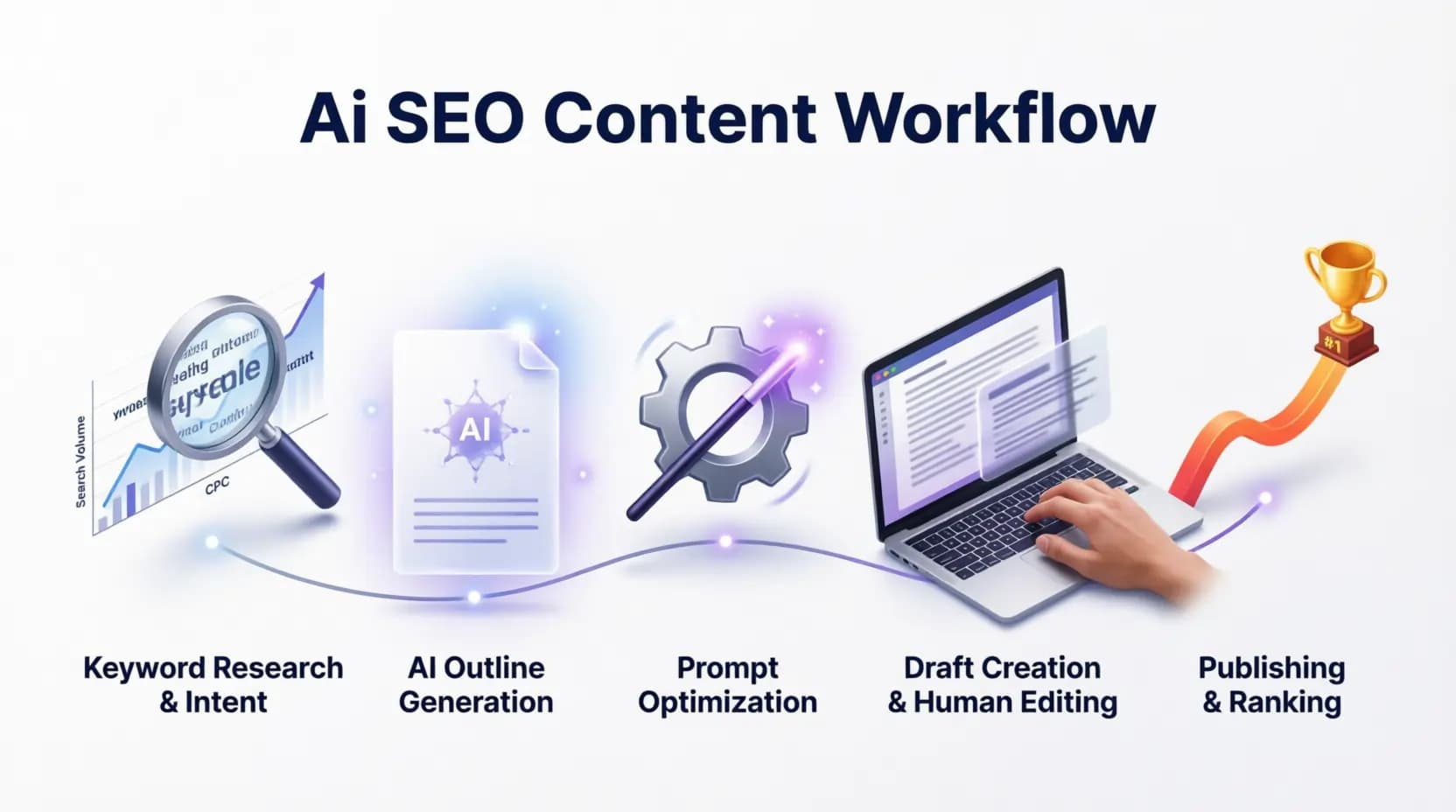
- Keyword Research & Intent Definition: Begin with thorough research to define the exact search intent behind each target keyword.
- Initial Draft Outline: Generate a first-draft outline using the AI SEO Generator for a structured starting point.
- Structural Comparison: Compare 2 to 3 possible structural outlines and choose the most logical one to prevent settling on a suboptimal structure.
- Prompt Refinement: Pass the strongest outline through the AI Prompt Optimizer to ensure the AI understands exactly what you need.
- Full Draft Generation: Create the complete draft, then manually enhance it with unique examples, internal links, and a strong CTA.
- FAQ Section Development: Build a dedicated FAQ section around real, verified search questions to capture featured snippets.
- Quality Review: Manually review the article for accuracy, tone, and E-E-A-T compliance. This non-negotiable step ensures quality.
- Content Repurposing: Repurpose the piece into social media snippets using the AI Social Media Content Generator to maximize ROI.
Common Mistakes That Kill Your SEO Performance
These are the recurring mistakes that account for most AI SEO content underperformance:
- Choosing a keyword that is too broad: Leads to unfocused content that cannot compete with established authorities. Fix: Narrow your focus to a specific aspect.
- Publishing the first draft unchanged: Guarantees generic, detectable AI content. Fix: Always run content through a human review process.
- Ignoring search intent: Writing a product pitch when the user wants an educational guide. Fix: Research the SERP to understand what currently ranks and why.
- Overusing the main keyword: Triggers spam filters and ruins readability. Fix: Reduce to a natural 1-2% density, focusing on synonyms.
- Forgetting internal links: Misses the opportunity to pass link equity. Fix: Add 3 to 5 relevant contextual links per article.
- Using vague subheadings: Wastes SEO real estate. Fix: Rewrite headings to include keywords and convey specific value.
- Writing long but low-value content: Prioritizes length over quality. Fix: Cut word count where needed while increasing value density.
The EEAT Framework: Building Trust That Ranks
What Is EEAT and Why Does It Matter?
EEAT stands for Experience, Expertise, Authoritativeness, and Trustworthiness—Google's framework for evaluating content quality. This matters even more for AI-assisted content, since it's the clearest signal that separates a page written with AI from a page written only by AI. Strengthening EEAT in AI content is less about adding a disclaimer and more about weaving real specifics — names, numbers, sources — into every section.
How to Build EEAT into Your AI SEO Content
- Experience: Share personal insights and case studies. Phrases like "In our testing, we found that..." show firsthand knowledge — but only use this if it's true; fabricated experience is easy for both readers and algorithms to spot.
- Expertise: Cite data and show depth of knowledge. Include statistics, research findings, and detailed analysis, and link to where those numbers came from.
- Authoritativeness: Reference credible sources. Linking to .edu, .gov, and industry leader sites helps build authority.
- Trustworthiness: Be transparent and accurate. Include author bios, update dates, and clear sourcing for your claims.
Frequently Asked Questions About AI SEO Content
Start Creating Content That Ranks Today
The difference between content that ranks and content that doesn't comes down to execution. Use this guide as your blueprint and start implementing the 12 tactics immediately.
Your AI SEO Content Action Plan
- Select your primary keyword and define intent using thorough keyword research tools.
- Generate your first outline with the AI SEO Generator.
- Refine your structure through the AI Prompt Optimizer.
- Create the full draft using the AI Article Prompt Generator.
- Build supporting content with the AI Social Media Content Generator.
- Complete the process with human editorial review and publication.
Additional Resources
- Prompt Engineering: Master Guide: Deep dive into prompt writing techniques.
- Best Free AI Prompt Generators: Compare top tools to choose the right solution.
- Complete Services List: Overview of all AI tools available for your workflow.
- Free Prompt Generator: Quick start for content ideation when you need inspiration immediately.
Final Thoughts: The Future of AI SEO Content
AI SEO content is not just about writing faster anymore. It's about building smarter, stronger, and more structurally sound pages that genuinely deserve to rank. The real competitive advantage comes from combining a solid keyword strategy, deep search intent understanding, better prompt engineering, strategic internal linking, and a rigorous human review process.
Remember These Key Takeaways:
- Intent is everything: Understanding why users search is the foundation of all successful SEO content.
- Structure matters: Logical, scannable content wins over dense, poorly organized writing.
- EEAT is essential: Demonstrating expertise and trustworthiness builds the credibility that rankings require.
- Internal linking is powerful: Building topical authority through strategic links strengthens your entire domain.
- Human review is non-negotiable: The AI + Human combination is the only path to consistently excellent content.
Ready to dominate search results? Create your first high-quality draft with the AI SEO Generator, improve it with the AI Prompt Optimizer, and explore all services to build a broader, more efficient content workflow for your team today.
You might also like

Master 12 proven ChatGPT prompt secrets: role prompting, chain-of-thought, custom instructions & GPTs. Updated for 2026.

The ultimate guide to optimizing your website and prompts for ChatGPT in 2026. Generative Engine Optimization (GEO), technical preparation, featured snippets, 15 practical ways to improve AI responses, and ready-to-use prompt templates.

Comprehensive ChatGPT vs Claude vs Gemini comparison. Discover which AI model is best for coding, writing, research, and business. Complete AI tools comparison guide with pricing, features, and use cases for 2026.

Discover how an AI prompt generator revolutionizes the way you work. A comprehensive guide to the best tools and how to use them for professional results in record time.